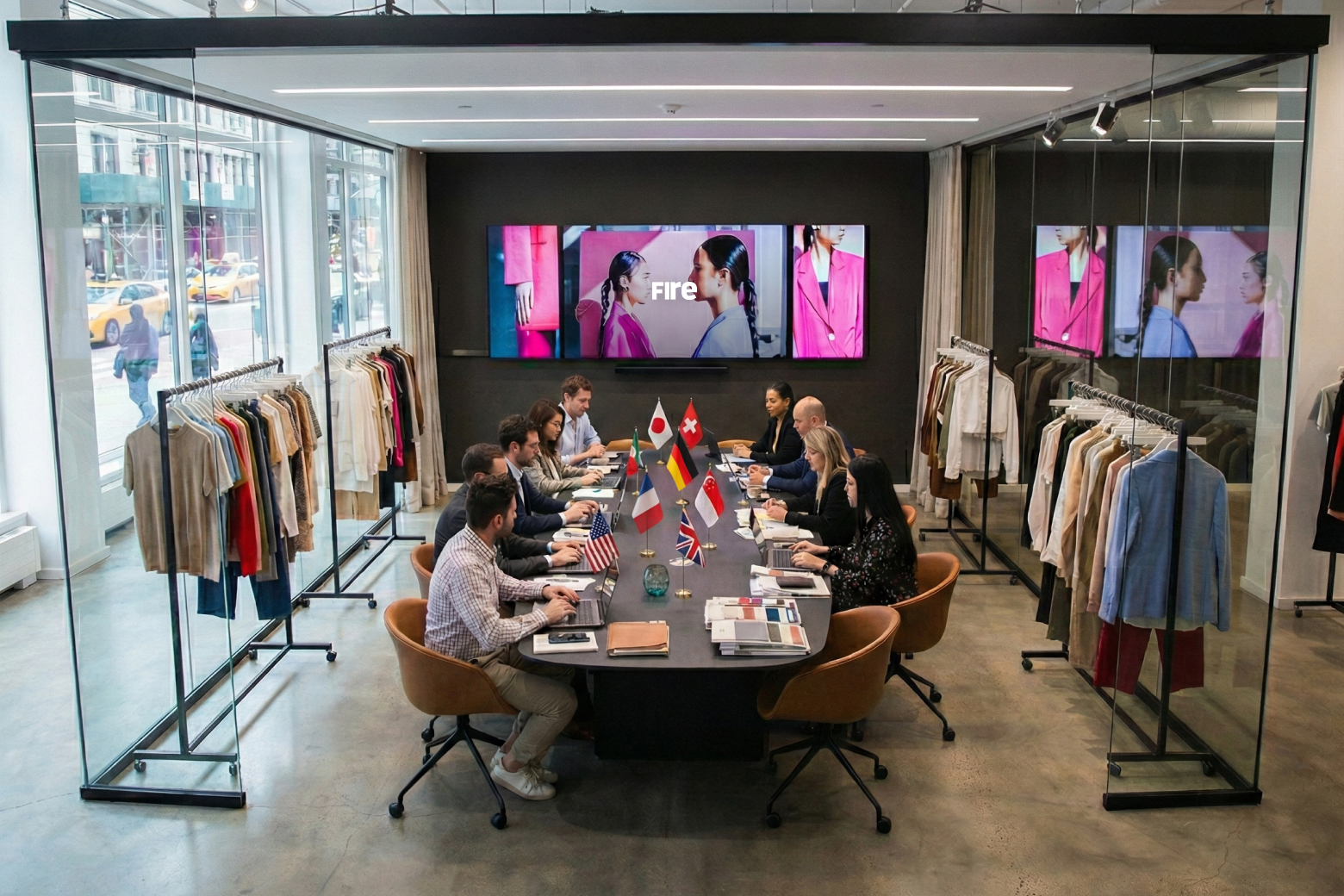
The End of Guessing
Gut feeling served fashion well for decades. But in a world of compressed seasons, global markets, and margin pressure, guessing is no longer a strategy. Data is.
This is why platforms like FIRE — processing nearly $10 billion in annual transactions — exist. They are building the autonomous future of fashion, one structured transaction at a time.
The Intelligence Era: What Changes Everything
Fashion is entering a fundamental transition from intuition-driven to intelligence-driven operations. For decades, the industry relied on creative judgment, relationship networks, and experience-based decision-making. These capabilities remain valuable — but they're no longer sufficient. Brands competing against intelligence with intuition alone will increasingly lose market position to competitors who combine creative excellence with data-driven precision.
The intelligence era doesn't replace human expertise — it amplifies it. Designers still set creative direction, but informed by sell-through data across markets and seasons. Merchandisers still curate assortments, but optimised by AI recommendations based on buyer behaviour patterns. Sales teams still build relationships, but armed with account-specific intelligence that transforms every conversation from reactive to proactive.
FIRE enables this transformation by providing the structured data foundation that intelligence requires. Processing nearly $10 billion in annual wholesale transactions for Hugo Boss, Bugatti Shoes, Drykorn, LVMH and 100+ leading fashion and lifestyle brands worldwide, the platform demonstrates that the intelligence era isn't a future vision — it's a present reality for brands that have built their data foundations (projected estimate).
Data Foundations: The Prerequisite for Every AI Application
Every AI application in fashion — demand forecasting, assortment optimisation, dynamic pricing, personalised recommendations, automated reordering — requires the same foundation: structured, comprehensive, longitudinal wholesale data. Without this foundation, even the most sophisticated algorithm produces unreliable results. With it, relatively simple models can outperform years of human experience.
Building this foundation requires three components. First, a unified platform that captures every wholesale interaction digitally — from showroom browsing to sell-out reporting. Second, a fashion-specific data model that handles size-colour matrices, seasonal lifecycles, and multi-market complexity natively. Third, ERP connectivity that synchronises enterprise data bidirectionally in real time. FIRE provides all three, with implementation typically completed within 10 weeks.
The data foundation compounds in value with every season. Season one provides baseline intelligence. Season two adds year-over-year comparisons. By season three, predictive models achieve accuracy levels that justify automation of routine decisions. By season five, brands operate with a level of intelligence that competitors starting from scratch cannot match for years — creating a permanent, self-reinforcing competitive advantage.
2026–2030: The Window That Determines Winners
The next four years will determine which fashion brands lead and which ones struggle for the following decade. Brands that build unified data platforms by 2027 will have 3–4 seasons of structured intelligence by 2030 — enough for predictive AI to operate autonomously across key wholesale decisions. Brands that delay until 2028 or beyond will face a structural disadvantage that no amount of subsequent investment can overcome.
The competitive dynamics are already visible. Brands on FIRE report measurable advantages within 2–3 seasons: better forecast accuracy, higher sell-through rates, lower sample costs, and deeper retailer relationships. These operational improvements generate immediate ROI while building the data asset that enables increasingly sophisticated AI applications in subsequent seasons.
The decision to act is urgent not because the technology is complex — FIRE deploys in 10 weeks — but because time is the irreplaceable ingredient in data compounding. Every season of structured data capture widens the intelligence gap. Every season without it narrows the window of opportunity. The brands processing nearly $10 billion annually through FIRE understood this early. The question for every other brand is: how much longer can you afford to wait? (projected estimate)